
Top 5 AI Tools for Threat Prioritization
Security teams face an overwhelming number of alerts daily, often spending hours sorting through them. AI-driven threat prioritization tools simplify this process by using machine learning to rank alerts based on risk, exploitation likelihood, and potential impact. These tools integrate with existing systems, reduce manual effort, and help teams focus on high-priority threats. Here are the top 5 platforms:
- The Security Bulldog: Uses NLP to analyze open-source intelligence and tailor threat insights to your environment. Saves up to 80% of manual research time.
- Check Point Infinity AI Platform: Leverages 50 AI engines to unify threat data across endpoints, networks, and cloud systems. Reduces false positives and automates responses.
- CrowdStrike Falcon: Processes trillions of events weekly, prioritizing endpoint threats with behavioral analytics and adversary intelligence.
- SentinelOne Singularity with Purple AI: Combines unified telemetry with AI-driven root cause analysis, simplifying threat investigations and response.
- IBM QRadar with AI-Enhanced Prioritization: Integrates Watson AI for dynamic risk scoring, compliance support, and automated workflows.
Quick Comparison
| Tool | Main Focus | Key Feature | Best For |
|---|---|---|---|
| The Security Bulldog | OSINT & tailored threat insights | NLP-based threat scoring | Teams needing curated external intelligence |
| Check Point Infinity | Unified threat management | AI-driven correlation across systems | Hybrid environments, Zero Trust frameworks |
| CrowdStrike Falcon | Endpoint threat detection | Adversary behavior analysis | Cloud-first and hybrid enterprises |
| SentinelOne Singularity | XDR & attack surface prioritization | AI-powered root cause analysis | Small SOCs, streamlined investigations |
| IBM QRadar | SIEM with cognitive analytics | Watson AI for compliance and scoring | Regulated industries like finance/healthcare |
Each tool addresses alert fatigue differently, so choose based on your team’s environment, compliance needs, and existing tools.
How AI Improves Threat Prioritization
AI enhances the way threats are prioritized by focusing on four key areas: behavior analysis, telemetry correlation, risk scoring, and guided response.
Behavior analysis helps define what "normal" activity looks like for users, devices, and applications. AI models monitor typical patterns like login locations, process activity, and data access, continuously updating these baselines. When deviations align with known attack behaviors, they are flagged as high-priority threats. For example, if an employee account logs in from a new country at 3:00 AM, accesses unfamiliar file shares, and downloads large amounts of data, behavior analysis identifies this as a potential credential theft case, not just a routine login. Similarly, it can detect ransomware by spotting rapid file encryption, even when dealing with new malware that lacks a known signature. This approach minimizes false positives by focusing on behavior combinations that indicate real threats, saving analysts from sorting through countless unnecessary alerts.
Telemetry correlation connects events across various security tools. Traditional systems often fail to link alerts from different sources, but AI uses machine learning to identify patterns across endpoints, networks, cloud platforms, identity systems, and threat intelligence feeds. Instead of presenting fragmented alerts, AI creates a unified incident narrative. For instance, it can link a phishing email, a compromised endpoint, unusual login attempts, privilege escalation, and data exfiltration into a single, coherent story. By correlating this data, AI provides a clearer picture of the attack, enabling better prioritization through risk scoring.
Risk scoring brings business context into the equation. AI-driven models evaluate threats based on factors like technical severity, exploitability, and how easily attackers could spread to other systems. They also incorporate live threat intelligence – if a vulnerability is actively being exploited or targeting your industry, the risk score increases. For example, threats to critical systems like payment platforms or customer databases are prioritized over similar issues on test environments. This method ensures that resources are focused on incidents with the greatest potential impact, rather than blindly following generic severity rankings.
Guided response automates the next steps after identifying and prioritizing threats. Once a risk score is assigned, the system suggests specific actions to contain the threat. For example, during a ransomware attack, it might recommend isolating affected endpoints and blocking command-and-control domains. In cases of credential theft, it could suggest enforcing multi-factor authentication, resetting passwords, and reviewing access logs. Many platforms now include natural language interfaces, allowing analysts to ask questions like, "Which endpoints are affected by this ransomware variant?" and receive immediate, actionable insights. These tools integrate with existing systems like SIEM, SOAR, EDR, and ticketing platforms, automating workflows such as incident creation and on-call notifications. For smaller security teams working around the clock, these automated responses ensure critical incidents are handled effectively, regardless of the analyst’s experience level or the time of day.
Together, these capabilities create a seamless process. Behavior analysis identifies suspicious activity early, telemetry correlation connects the dots across systems, risk scoring prioritizes threats based on both technical and business factors, and guided response automates containment and investigation. Organizations report seeing 30–70% fewer alerts after correlation and deduplication, fewer false positives, and investigation times reduced from hours to minutes. For teams in the U.S. managing complex environments, remote workforces, and strict compliance standards, AI-driven threat prioritization allows them to focus on the threats that matter most – those targeting critical data, infrastructure, or high-value assets.
1. The Security Bulldog

The Security Bulldog is an AI-powered platform designed to simplify cybersecurity intelligence by cutting through the overwhelming volume of open-source data. Using its proprietary Natural Language Processing (NLP) engine, it processes millions of cybersecurity documents daily – ranging from threat reports and vulnerability disclosures to dark web activity and security advisories. The result? Actionable insights tailored specifically to your organization’s environment. This foundation supports advanced threat scoring, enriched context, seamless integrations, and automated responses.
AI-Driven Threat Scoring and Prioritization
The platform’s NLP engine assigns risk scores to threats by analyzing factors like exploit availability, affected technologies, vulnerability severity, and how relevant they are to your IT environment. Instead of generic feeds, The Security Bulldog creates a curated knowledge base tailored to your industry, company, and technology stack.
"Our proprietary natural language processing engine processes and presents the data they need in a user-friendly way to reduce cognitive burden, improve decision making, and quicken remediation." – The Security Bulldog
For example, when a zero-day vulnerability is disclosed, the NLP engine identifies the threat, cross-references it with your asset inventory, and flags it as high priority if your systems are affected. This enables your team to address the risk within hours instead of days. Similarly, it can analyze dark web chatter to detect phishing campaigns targeting your industry, helping you quickly update email rules and launch awareness campaigns.
The platform saves security teams up to 80% of the time they would typically spend on manual research. For U.S.-based teams managing complex environments with limited staff, this time savings translates into faster responses and better resource allocation.
Contextual Enrichment and Correlation of Telemetry
Beyond scoring threats, The Security Bulldog enhances its intelligence by combining external data with your internal context. It integrates information like asset inventories, vulnerability scans, and business-critical tags. The NLP engine identifies entities such as CVEs, IP addresses, domains, and malware families from threat reports, mapping them directly to your systems. For instance, if a report mentions a specific CVE, the platform checks whether it impacts your environment and adjusts the risk score accordingly.
The platform also tracks related threats over time, identifying campaigns and trends when multiple sources report on the same threat actor. This approach provides a clearer picture for prioritizing responses.
"The Security Bulldog’s NLP-based platform creates an OSINT knowledge base, curated for your industry, company, IT environment and workflow, which enables your team to quickly respond to immediate threats and clear out your ticket backlog." – The Security Bulldog
For instance, a financial institution using The Security Bulldog to monitor threats against SWIFT systems or online banking platforms would receive intelligence filtered specifically for those technologies. It also considers regulatory requirements like FFIEC and GLBA, ensuring that identified threats align with your actual attack surface instead of generic global risks.
Integration with Existing Security Tools
The Security Bulldog integrates effortlessly with existing security tools, including SIEMs like Splunk, Microsoft Sentinel, and IBM QRadar, as well as SOAR platforms and IT service management tools like ServiceNow. Through APIs and connectors, it pushes enriched alerts into these systems, automatically creating high-severity incidents and triggering playbooks within a minute.
This integration ensures that prioritized threats are immediately actionable within your existing workflows, eliminating the need for analysts to juggle multiple tools. Additionally, the platform centralizes research notes, hypotheses, and decisions, improving consistency across shifts – especially valuable for smaller security teams working around the clock.
Automation of Response Workflows
The Security Bulldog streamlines response workflows by integrating with SOAR and orchestration platforms. Based on prioritized threats, it can automate actions such as creating high-priority tickets, initiating vulnerability scans, or enriching SIEM alerts with contextual data and recommended steps.
For critical threats, like the active exploitation of a vulnerability in your environment, the platform can automatically generate a playbook in your SOAR tool. This playbook might include isolating affected systems, blocking malicious IPs at the firewall, and notifying the incident response team. These automated actions significantly accelerate response times for high-priority incidents.
The Security Bulldog offers flexible pricing plans to accommodate U.S. security teams. The Enterprise plan starts at $850/month or $9,350/year, supporting up to 10 users with features like MITRE ATT&CK coverage, CVE database access, the NLP engine, semantic analysis, custom feeds, integrations, and 24/7 support. For larger teams, the Enterprise Pro plan includes everything in the Enterprise package, along with custom SOAR/SIEM integrations, metered data usage, and additional training support. Pricing for the Enterprise Pro plan is customized based on team needs.
2. Check Point Infinity AI Platform
Check Point Infinity, as highlighted by The Security Bulldog, stands out as another AI-powered solution designed to streamline threat prioritization. Built on the ThreatCloud system, this cybersecurity platform gathers intelligence from 50 AI engines and millions of endpoints, making it a strong choice for U.S. teams managing hybrid environments.
AI-Driven Threat Scoring and Prioritization
Infinity uses its AI-based threat prevention engines and SOC analytics to automatically rank and score threats. It evaluates factors like severity, exploitability, and potential business impact to prioritize threats effectively. By consolidating duplicate alerts and filtering out low-confidence signals, it helps reduce alert fatigue for security teams. Case studies and independent reports show that organizations using Infinity often see reduced false positives and faster detection and response times – sometimes cutting response times from days to mere hours.
Contextual Enrichment and Telemetry Correlation
Infinity provides a full picture of security incidents by combining data from network gateways, endpoints, cloud workloads, email security systems, and identity management tools. It also integrates proprietary threat feeds and third-party intelligence. What sets it apart is its ability to correlate events across different attack vectors – like phishing, malware, and lateral movements – into a cohesive incident narrative. This includes valuable context, such as MITRE ATT&CK mappings and connections to known threat actors. Unlike platforms that just identify threats, Infinity’s detailed scoring and enriched intelligence give teams the tools they need to act decisively. This depth of context also makes it easier to integrate with existing security tools.
Integration with Existing Security Tools
Check Point Infinity supports seamless integration with tools like SIEM platforms (e.g., Splunk, Microsoft Sentinel, QRadar) and SOAR systems through APIs, syslog export, and prebuilt connectors. When paired with solutions such as SentinelOne Singularity with Purple AI or CrowdStrike Falcon, Infinity acts as a cross-domain correlation layer. It enhances endpoint alerts with network and cloud context, enabling coordinated actions like blocking threats or segmenting compromised areas.
Automation of Response Workflows
Infinity automates response workflows by triggering playbooks for actions like quarantining endpoints, blocking malicious IPs, updating firewall rules, disabling compromised accounts, or sandboxing suspicious files – all based on AI-generated risk scores. Fully automated responses, such as isolating compromised devices, ensure rapid action. For more sensitive steps – like disabling privileged accounts or implementing major firewall updates – semi-automated workflows requiring analyst approval strike a balance between speed and governance. Experts often suggest starting with a monitor-only mode to compare Infinity’s threat scoring with existing triage methods. Over time, teams can enable automated responses for high-confidence scenarios. U.S. SOC teams typically map Infinity’s threat scores to priority levels (e.g., P1) and fine-tune thresholds based on post-incident reviews.
For hybrid infrastructures, Infinity is often deployed as a cloud-based management layer, with both on-premises and cloud-native enforcement points feeding telemetry. Key deployment considerations include ensuring adequate log ingestion capacity for peak traffic, complying with data residency requirements, standardizing log formats for SIEM integration, and rolling out the platform in phases to refine AI-driven policies before scaling up to larger operations.
3. CrowdStrike Falcon With AI Analytics
CrowdStrike Falcon uses machine learning and behavioral analytics to transform endpoint data into actionable, prioritized alerts. This enables U.S. security teams to respond immediately. With intelligence gathered from monitoring over 230 adversary groups worldwide, Falcon’s AI models provide insights into not just what happened during an attack, but also who might be responsible and why it matters. These capabilities lay the groundwork for Falcon’s advanced AI modules, which are explored below.
AI-Driven Threat Scoring and Prioritization
Falcon assigns AI-generated scores to detections, aligning tactics with frameworks like MITRE ATT&CK and offering actionable recommendations. For security operation centers (SOCs), this means incidents are logically grouped and ranked. For instance, an attempted lateral movement involving credential theft on domain controllers would be prioritized over a malware detection in a low-risk kiosk environment.
The Falcon X Intelligence module enriches live detections with global adversary data, while Charlotte AI simplifies alerts by summarizing key details, drastically cutting investigation time. Falcon X provides additional context, such as the threat actor’s identity, campaign details, and exploitation risks, refining each detection’s risk score. Meanwhile, Charlotte AI translates complex technical findings into plain language, making it easier for less-experienced analysts to make informed decisions without needing deep expertise in endpoint detection and response (EDR).
For smaller SOCs, Falcon’s default AI scoring is immediately useful. Larger organizations often customize these scores, integrating them into broader SIEM and SOAR pipelines as part of a mature risk-based prioritization process.
Contextual Enrichment and Correlation of Telemetry
Falcon aggregates process data, network activity, user behavior, and threat intelligence into a unified timeline, making it easier for analysts to identify attack patterns. The platform collects telemetry data – like process executions, network connections, and registry changes – and organizes it into "incident trees" that map out entire attack sequences rather than isolated events. AI models and Falcon X Intelligence add layers of context, such as identifying malware families, linking adversary groups, and correlating indicators of compromise with current global campaigns.
For example, a seemingly harmless PowerShell execution might initially go unnoticed. But when Falcon correlates it with credential theft attempts and lateral movement tied to a known ransomware group, the detection is elevated to high priority. This level of detail supports faster, more decisive responses and helps teams focus on threats that could disrupt critical systems or compromise sensitive data. The enriched context also powers automated workflows, ensuring timely containment of threats.
Integration with Existing Security Tools
CrowdStrike Falcon provides REST APIs, prebuilt connectors, and log streaming options to integrate seamlessly with major SIEM platforms like Splunk, Microsoft Sentinel, and IBM QRadar. This ensures that Falcon’s AI-prioritized detections appear in the central SIEM as enriched, actionable events rather than raw endpoint logs. For SOAR tools, Falcon supports playbook-based integrations, enabling automated workflows such as host isolation, ticket creation in ITSM tools, or notifications in collaboration platforms – all triggered by the detection’s AI-assigned priority level.
This integration allows SOCs to set up response pipelines where only high-severity detections trigger automated remediation. For example, detections with "high" or "critical" scores might initiate auto-remediation, while low-risk alerts are filtered out. Falcon’s ability to correlate endpoint alerts with data from other tools, like email or network logs, provides a complete view of multi-vector attacks without requiring manual data assembly.
Automation of Response Workflows
Falcon can automatically respond to critical detections by isolating compromised endpoints or quarantining malicious files. Many U.S. organizations implement tiered response strategies to balance speed and safety. For instance, full auto-isolation might only be enabled for detections linked to known ransomware or active attacks, while medium-severity events might trigger less disruptive actions, such as generating alerts or gathering additional data.
Charlotte AI enhances these workflows by suggesting response actions that require human approval for more sensitive operations. This approach ensures rapid response times while maintaining control over critical decisions. Organizations can align Falcon’s severity levels with their own risk policies, prioritizing detections involving endpoints that handle sensitive data, such as protected health information or cardholder data under HIPAA or PCI DSS regulations.
One example from a mid-sized U.S. financial services SOC highlights Falcon’s impact. Before adopting Falcon, analysts manually pieced together logs in their SIEM to reconstruct attack chains, a process that took hours. After deploying Falcon, detections arrived pre-grouped with attack context and recommended actions. Automated host isolation for high-severity threats, like credential dumping followed by lateral movement, significantly reduced response times while AI-driven filtering cut down on false positives.
To fine-tune Falcon’s AI-driven threat scoring and automation, teams can start with "audit" or "recommend-only" modes. This allows them to collect data on potential actions before enabling full automation in limited environments, such as test systems. Regularly reviewing Charlotte AI’s summaries and Falcon X Intelligence correlations during post-incident analysis helps refine rules, ensuring that AI scores align more closely with the organization’s specific risk priorities.
sbb-itb-9b7603c
4. SentinelOne Singularity With Purple AI
SentinelOne Singularity is a cloud-native XDR platform designed to unify data across endpoints, cloud environments, and identity systems to detect and prioritize threats. Purple AI serves as a security co-pilot, assisting analysts with routine investigations. What makes Singularity stand out is its combination of unified telemetry and Purple AI’s investigative capabilities, which simplifies incident management and lays the groundwork for advanced threat scoring.
AI-Driven Threat Scoring and Prioritization
Singularity uses self-learning algorithms to establish normal behavioral baselines, enabling it to identify unusual activities like abnormal encryption or privilege escalation. Its Cyber AI Analyst™ then correlates these alerts and assigns precise risk scores, helping reduce alert fatigue while ensuring critical threats are prioritized.
Contextual Enrichment and Unified Telemetry
The platform brings together data from endpoints, identities, and cloud systems, presenting it as a single, cohesive incident narrative. This enriched context allows analysts to differentiate between isolated anomalies and orchestrated attacks. By mapping the sequence of an incident – from the initial breach to potential lateral movement – security teams can better focus their response efforts where it matters most.
Integration With Existing Security Tools
Singularity is designed to work seamlessly with top SIEM and SOAR solutions via APIs and built-in connectors. AI-prioritized alerts feed directly into these workflows, enabling coordinated and automated remediation efforts without disrupting existing processes.
Automation of Response Workflows
Beyond integration, Singularity automates response actions to handle threats swiftly. The platform can automatically isolate compromised endpoints, terminate malicious processes, and even roll back systems affected by ransomware using Windows shadow copies. These automated workflows significantly reduce the time it takes to detect and respond to incidents (MTTD and MTTR), allowing organizations to address critical threats quickly and efficiently.
5. IBM QRadar With AI-Enhanced Prioritization
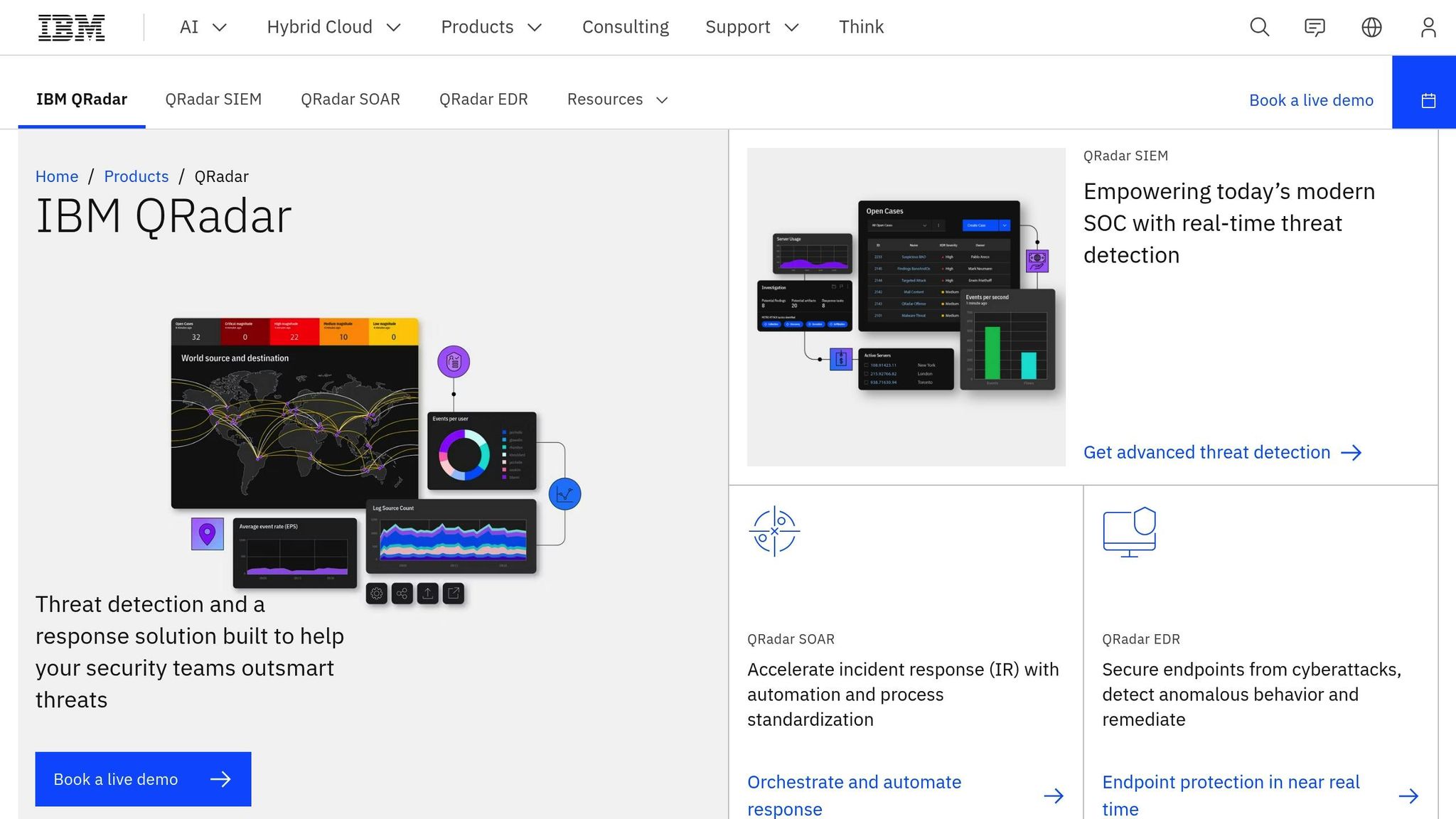
IBM QRadar, a well-established SIEM platform, now incorporates Watson AI to deliver advanced security capabilities. It consolidates data from various sources into a single view. What makes QRadar stand out is its Cognitive SOC Analyst feature, which acts as an AI-powered assistant to streamline threat investigations and lighten workloads. This is particularly beneficial for industries such as finance and healthcare, where compliance and precise threat detection are crucial.
AI-Driven Threat Scoring and Prioritization
QRadar leverages Watson AI to analyze telemetry and threat intelligence, establish behavioral norms, and identify anomalies. By applying machine learning models, it uncovers patterns linked to both known and emerging threats. Each incident is assigned a dynamic risk score based on factors like the severity of the attack, the importance of the affected asset, its exposure level, and historical data.
For instance, QRadar can link a suspicious login attempt to a known malware signature targeting a high-value asset, automatically raising the incident’s priority. The Cognitive SOC Analyst feature uses natural language processing (NLP) to allow analysts to query threat data in plain English. Junior analysts can ask straightforward questions and receive clear insights, while seasoned team members can dive deeper into investigations with AI-generated summaries and actionable recommendations. This intelligent prioritization enables faster and more effective responses.
Contextual Enrichment and Correlation of Telemetry
QRadar enriches and correlates telemetry by processing logs and events from sources like endpoints, network devices, cloud platforms, identity solutions, and applications. It adds context by incorporating details such as asset importance, user roles, and business impact, resulting in more precise risk evaluations.
For example, a failed login attempt by a low-privilege user on a non-critical server might be deprioritized. However, the same behavior from a privileged account on a domain controller would trigger a high-risk alert. QRadar also integrates external threat intelligence from IBM X-Force, which includes data from IBM’s global sensor network and their research team. This provides details like vulnerability data, malware indicators, and mappings to the MITRE ATT&CK framework, helping security teams assess the urgency and potential impact of threats.
In hybrid and cloud environments, QRadar’s AI analyzes telemetry from platforms like AWS, Azure, and GCP alongside on-premises data. Watson AI evaluates factors such as the scope of exposure, asset importance, and cross-environment risks. For instance, if AI detects suspicious API activity in a cloud instance that aligns with unusual internal network traffic, QRadar can flag the event as a high-risk lateral movement attempt, ensuring swift containment across the attack surface.
Integration With Existing Security Tools
QRadar serves as a central SIEM platform, seamlessly integrating with a wide range of security tools. It connects with SOAR platforms like IBM Resilient, endpoint detection and response (EDR) tools, firewalls, cloud security solutions, and vulnerability scanners through robust APIs and pre-built connectors. This allows QRadar to unify data from multiple sources into a single, normalized view.
For example, if a suspicious process on an endpoint matches a high-confidence threat indicator from X-Force, QRadar raises the incident’s priority and provides actionable insights. These integrations ensure AI-prioritized alerts flow smoothly into existing SOC workflows without requiring significant changes to the architecture. Additionally, QRadar can automatically initiate containment actions when necessary, enhancing the efficiency of security operations.
Automation of Response Workflows
With its AI-driven insights, QRadar – especially when paired with IBM Resilient (SOAR) – enables automated responses to high-priority threats. When Watson AI identifies a critical incident, QRadar can take immediate action, such as isolating compromised endpoints, blocking malicious IPs, disabling suspicious accounts, or creating tickets in IT service management systems.
For instance, if AI detects ransomware-like activity on a key server and links it to a known malicious IP, QRadar can activate a playbook that isolates the affected system, blocks the IP, and alerts the incident response team. These automated actions are executed through integrations with endpoint security tools, network devices, and cloud services, significantly reducing response times. By automating repetitive tasks, QRadar allows security teams to concentrate on strategic efforts, improving overall efficiency and effectiveness in managing threats.
Feature Comparison Table
Below is a comparison of five AI-powered threat prioritization platforms, focusing on their unique strengths, AI capabilities, data sources, and how they address modern security challenges. This overview highlights how these tools help reduce alert fatigue and concentrate on critical threats.
| Tool | Primary Focus | AI Prioritization Features | Data Sources | Strengths for Threat Prioritization |
|---|---|---|---|---|
| The Security Bulldog | Threat Intelligence & OSINT Prioritization | Proprietary NLP engine for automated analysis of open-source intelligence; environment-specific threat curation; risk-based filtering | Open-source cyber intelligence (OSINT), dark web monitoring, vulnerability feeds, threat actor research, MITRE ATT&CK framework, CVE databases | Cuts manual research time by 80% with curated intelligence; delivers environment-specific insights; integrates seamlessly with existing SOC tools |
| Check Point Infinity AI Platform | Unified XDR & Network/Cloud Security | 50 AI engines within the ThreatCloud system; automated correlation across the attack surface; risk scoring based on IoC matches and attack context; automated remediation workflows | Data from millions of endpoints, network sensors, cloud workloads, and Check Point Research team (IoCs, malware signatures, attack patterns) | Provides a unified view across network, cloud, and endpoints; enables automated threat blocking and device isolation; integrates with Zero Trust and SASE frameworks |
| CrowdStrike Falcon with AI Analytics | Endpoint-Centric XDR & Threat Prioritization | Machine learning models trained on trillions of weekly security events; behavioral baselining and anomaly detection; adversary behavior pattern recognition; cross-correlation of users, devices, and workloads | Global endpoint telemetry (trillions of events weekly), Falcon X threat intelligence, adversary research and hunting data | Delivers precise endpoint threat detection with minimal false positives; focuses on real attacker behavior; rapidly identifies complex attack chains; offers robust adversary intelligence |
| SentinelOne Singularity with Purple AI | AI-Driven XDR & Attack Surface Prioritization | Purple AI engine for natural language threat hunting; automated root cause analysis; continuous attack surface management; risk scoring based on impact and exploitability | Endpoint telemetry, cloud workload data, identity systems, network traffic, vulnerability databases, and integrated threat intelligence feeds | Speeds up investigations with AI-driven root cause analysis; reduces analyst workload through natural language queries; prioritizes threats based on business impact; provides ongoing visibility into vulnerabilities |
| IBM QRadar with AI-Enhanced Prioritization | Enterprise SIEM & Cognitive Threat Prioritization | Watson AI for cognitive analytics; dynamic risk scoring based on severity, asset importance, exposure, and historical data; NLP-powered Cognitive SOC Analyst; statistical models for event correlation; MITRE ATT&CK mapping | Enterprise logs (network, endpoints, applications), IBM X-Force threat intelligence, external threat feeds, cloud platform telemetry (AWS, Azure, GCP), identity solutions | Excels in compliance and regulatory support for finance and healthcare; reduces MTTR with cognitive analytics; provides detailed context on asset criticality and business impact; integrates with a broad ecosystem of tools |
Each platform takes a distinct approach to addressing threat prioritization challenges. For organizations drowning in open-source intelligence, The Security Bulldog offers a solution that cuts manual research time by 80% and highlights the most relevant external threats for their environment.
Check Point Infinity, on the other hand, shines with its unified view of threats across network, cloud, and endpoint environments, powered by its ThreatCloud system.
CrowdStrike Falcon leverages its massive global telemetry to detect sophisticated attacker behaviors, ensuring accurate endpoint threat prioritization while reducing alert overload.
SentinelOne Singularity, with its Purple AI engine, stands out for its natural language threat hunting and ability to prioritize threats based on actual business impact, making it a strong choice for teams looking to streamline investigations.
Finally, IBM QRadar combines cognitive analytics with deep compliance insights, making it ideal for enterprises that need to balance threat prioritization with regulatory requirements and business-critical considerations.
Choosing the right platform depends on your team’s specific needs – whether it’s managing OSINT, achieving unified visibility, improving endpoint detection, or aligning threat prioritization with business and compliance goals.
Conclusion
Summing up the evaluations above, here’s a breakdown of how each platform aligns with various priorities, environments, and security challenges:
- The Security Bulldog: This platform uses a proprietary NLP engine to sift through open-source intelligence, cutting manual research time by 80% while delivering tailored threat insights for your environment.
- Check Point Infinity AI Platform: With its ThreatCloud system, this platform offers a unified view across network, cloud, and endpoint environments. It’s a solid option for organizations aiming for streamlined security management with Zero Trust and SASE features.
- CrowdStrike Falcon: Processing trillions of security events every week, CrowdStrike Falcon excels at identifying sophisticated attacker behaviors with minimal false positives. It’s an ideal choice for cloud-first and hybrid enterprises.
- SentinelOne Singularity with Purple AI: This tool shines in natural language threat hunting and prioritizing threats based on business impact. It’s particularly helpful for small SOC teams, offering AI-powered root cause analysis and one-click remediation.
- IBM QRadar with AI-Enhanced Prioritization: Combining advanced analytics with compliance-focused features, IBM QRadar is a strong fit for sectors like finance, healthcare, and government, where regulatory compliance is critical.
When choosing a platform, assess your current threat prioritization processes by examining workflows, measuring detection and response times, and spotting any gaps. Factor in your existing security tools, telemetry types, automation capabilities, threat scoring methods, compliance requirements, and, of course, your budget and staffing limits.
The right solution should minimize alert fatigue, reduce false positives, and empower your analysts to act faster and with greater confidence. Select the platform that best cuts through the noise and speeds up response times in your specific security landscape.
FAQs
How do AI-powered tools like The Security Bulldog work with existing security systems to improve efficiency?
AI-driven tools like The Security Bulldog are built to work hand-in-hand with your current cybersecurity systems and workflows. By integrating with the tools you already rely on, they improve teamwork, simplify processes, and cut down on the time spent manually analyzing threats.
With capabilities such as vulnerability management, tailored threat feeds, and automation, The Security Bulldog enables security teams to spot and prioritize risks more efficiently. This seamless integration supports quicker decision-making and a faster response to potential threats, helping your organization stay one step ahead of cyber risks.
How do AI models assign risk scores to cybersecurity threats?
AI models, like those powering The Security Bulldog, examine various factors to determine risk scores for potential threats. These factors typically include how severe a vulnerability is, the chances it could be exploited, and the possible consequences for systems or data.
The Security Bulldog uses advanced Natural Language Processing (NLP) to sift through massive amounts of open-source cyber intelligence. This allows security teams to quickly pinpoint and prioritize the threats that matter most, streamlining their workflow and improving decision-making. By integrating effortlessly with existing tools, it speeds up detection and response processes while delivering tailored insights designed for specific IT environments.
What factors should organizations consider when choosing an AI tool for prioritizing cyber threats and meeting compliance requirements?
When choosing AI tools, it’s essential to assess how well they work with your current systems, their ability to deliver useful insights, and whether they help meet industry compliance standards. Look for features such as real-time threat analysis, vulnerability management, and customizable feeds that align with your IT setup.
The Security Bulldog provides an AI-powered platform built to assist security teams in simplifying threat research, making better decisions, and reacting to threats more quickly. With its proprietary NLP engine, it processes open-source intelligence efficiently, saving time and boosting the productivity of cybersecurity operations.