
AI vs. Manual Threat Intelligence: What Startups Need
Startups face a tough choice when it comes to cybersecurity: rely on AI-powered tools or stick with manual threat analysis. Here’s the bottom line: AI offers speed and scalability, while manual methods provide deeper context for complex threats. For startups with limited resources, AI-driven solutions like The Security Bulldog can save time, reduce workload, and enable faster responses to cyber threats. But manual analysis still has a role in handling nuanced, targeted attacks.
Key Points:
- AI-powered tools process large data volumes in real time, cutting research time by up to 80%.
- Manual methods excel in interpreting complex and context-specific threats but are slower and resource-intensive.
- A hybrid approach combines AI’s efficiency with human expertise for better results.
- Startups should consider budget, team size, and threat complexity when choosing a strategy.
Quick Comparison:
| Factor | AI-Powered Methods | Manual Methods |
|---|---|---|
| Speed | Real-time detection | Days to weeks |
| Scalability | Handles increasing data easily | Requires hiring more analysts |
| Accuracy | Consistent, fewer false positives | Prone to human error |
| Cost | Higher upfront, lower over time | Lower upfront, higher ongoing |
| Best Use | Routine monitoring, 24/7 defense | Complex, targeted attacks |
Takeaway: For startups, AI-powered solutions are often the best fit for handling massive data and ensuring quick threat responses. Manual analysis can complement AI for deeper investigations. A hybrid approach balances speed and insight.
AI-Powered Threat Intelligence: Features and Benefits
What AI-Driven Threat Intelligence Can Do
AI-driven threat intelligence takes the heavy lifting out of threat detection and analysis. By using machine learning algorithms, these systems scan enormous volumes of data from various sources, identifying patterns and anomalies with incredible speed.
At the core of these systems are Natural Language Processing (NLP) engines, which process millions of documents daily. But they don’t just gather data – they interpret context, eliminate irrelevant information, and deliver actionable insights in a way that security teams can easily understand and act on.
This automation goes far beyond just collecting data. With real-time monitoring that works around the clock and contextual threat detection, AI tools help security teams grasp not only what the threat is but also how it might affect their specific environment. This constant vigilance allows startups to maintain robust security without needing 24/7 human staffing, enabling quicker and more informed responses.
These capabilities deliver operational advantages that are particularly impactful for startups.
How AI Tools Help Startups
AI tools do more than just monitor threats – they transform how startups manage their resources. By saving up to 80% of the time typically spent on manual research, these tools allow startups to scale without needing to expand their teams proportionally. For small teams where everyone juggles multiple responsibilities, this time-saving efficiency directly boosts overall productivity.
Another key benefit is the reduction of cognitive burden on security teams. Instead of drowning analysts in raw data, AI tools filter and prioritize information, making decision-making faster and more effective. This streamlined approach helps avoid analyst burnout and improves the quality of security responses.
What makes AI systems even more valuable is their adaptive learning ability. They continuously refine their detection accuracy by learning from new threats, meaning the system gets better over time. Unlike manual methods, these platforms evolve to handle increasingly complex threat scenarios, strengthening a startup’s security posture automatically.
The Security Bulldog: AI-Powered Solution for Startups
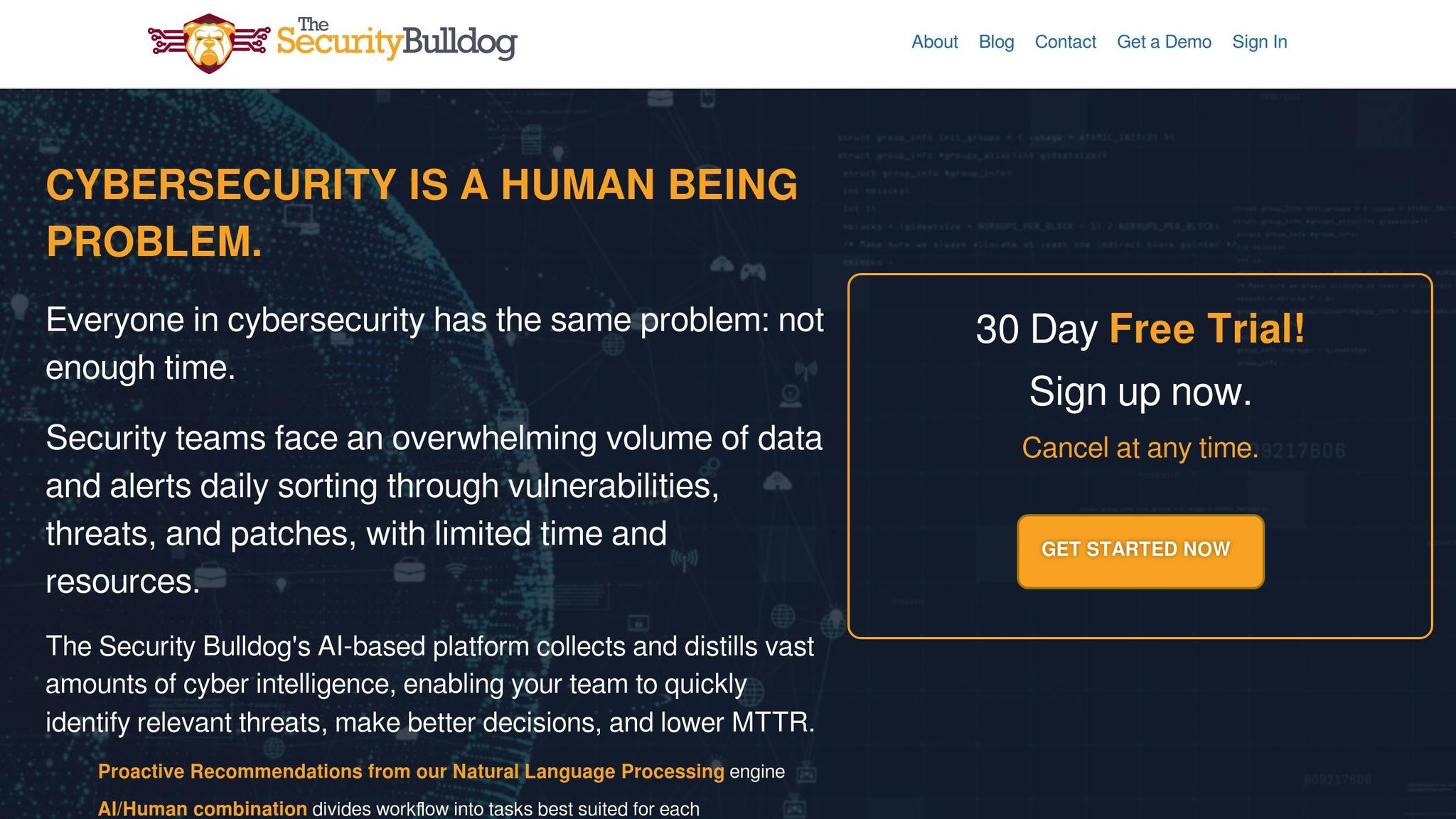
The Security Bulldog is a standout AI-powered solution designed to tackle the specific challenges startups face. Using its proprietary NLP engine, it processes millions of documents daily, delivering proactive recommendations that keep teams ahead of emerging threats.
"The Security Bulldog‘s AI-based platform collects and distills vast amounts of cyber intelligence, enabling your team to quickly identify relevant threats, make better decisions, and lower MTTR."
The platform’s hybrid approach optimizes workflows by assigning repetitive, time-consuming tasks to AI, while leaving high-value decision-making to human analysts. This division of labor ensures teams can focus on what truly matters.
Another strength of The Security Bulldog is its integration capabilities. It works seamlessly with existing security tools, meaning startups don’t have to overhaul their current systems. This compatibility allows teams to start benefiting from AI-driven threat intelligence almost immediately, without the hassle of a lengthy setup.
The platform also offers multiple custom feeds, tailoring threat intelligence to the specific needs of each user. By cutting through irrelevant alerts, it ensures security teams can concentrate on threats that are most relevant to their operations. Combined with its 24/7 proactive defense, The Security Bulldog delivers enterprise-level monitoring without the need for a large security team.
"Our proprietary natural language processing engine processes and presents the data they need in an easily digestible format to reduce cognitive burden, improve decision making, and quicken remediation."
For startups considering AI-powered security solutions, The Security Bulldog provides a 30-day free trial, giving teams the chance to experience its benefits firsthand before committing financially.
Threat Intel, Startups & Scaling Europe’s Cyber Future with Marco Riccardi
Manual Threat Intelligence: Pros and Cons
As startups evaluate their threat intelligence strategies, it’s important to weigh the strengths and weaknesses of manual analysis.
What Manual Analysis Does Well
Manual threat intelligence brings something machines can’t replicate: human intuition and creativity. When it comes to handling complex attacks, human experts shine by interpreting ambiguous signals and uncovering the deeper context behind threats.
Security analysts are particularly skilled at identifying advanced persistent threats (APTs) and highly targeted attacks that demand a nuanced understanding of context. For instance, a human analyst might detect a slow-moving, "low-and-slow" attack designed to evade automated systems. They can also identify social engineering campaigns that exploit an organization’s culture or workflows – something that requires a deep understanding of human behavior and company-specific dynamics.
This ability to contextualize threats is especially valuable for startups with unique business models or niche markets. Analysts can tailor their approach to a company’s specific needs, considering not just the nature of the threat but also its potential impact on operations, customers, and competitive positioning.
Manual analysis also excels when novel threats emerge. Human creativity allows analysts to predict new attack methods and understand attacker motives in ways that algorithms, which rely on predefined patterns, simply cannot. However, despite these strengths, manual threat intelligence faces significant challenges that limit its scalability and speed.
Where Manual Threat Intelligence Falls Short
While human analysis offers depth, it struggles to keep up with the sheer volume of modern cyber threats. One of the biggest challenges is time. Security teams often spend hours each morning just figuring out what broke, whether it affects them, and how to address it – all while juggling an endless flow of vulnerabilities, threats, and patches.
"Cyber teams are so overwhelmed that they don’t have time to save time as they struggle with the same problem: they wake up in the morning and spend two to three hours to find out what broke, does it affect them, and, if it does, how to fix it." – The Security Bulldog
The inherent limitations of human processing speed make scalability a major issue, especially as startups grow. Manual methods often require hiring more analysts to handle the increasing volume of data, which can quickly strain budgets. For startups operating on tight finances, the cost of expanding security teams may be out of reach. Automated solutions, by contrast, can reduce research time by up to 80%, offering a more budget-friendly alternative.
Another drawback is the mental strain on security analysts. The sheer volume of data can overwhelm even the most skilled professionals, leading to fatigue and reduced decision-making quality. This can result in missed threats or delayed responses to critical incidents.
Manual methods are also slower when it comes to detecting threats. Detection times can range from several days to weeks, leaving vulnerabilities exposed while threats evolve and spread. On top of that, human error can lead to inconsistent assessments. Different analysts might interpret the same threat in varying ways, potentially overlooking vulnerabilities or triggering false alarms that waste valuable resources.
These limitations underscore why many startups are turning to AI-driven solutions, which offer faster, more scalable, and cost-effective alternatives for managing today’s complex threat landscape.
sbb-itb-9b7603c
AI vs Manual Threat Intelligence: Side-by-Side Comparison
Building on the earlier overview, here’s a closer look at how AI and manual methods compare in practice, especially for startups navigating limited resources.
Main Differences Between AI and Manual Methods
When it comes to speed and processing power, the contrast is striking. AI systems work in real time, offering instant detection and response, while manual methods rely on periodic analysis, which delays the identification of threats.
Another major difference lies in data coverage. AI-driven systems can process vast amounts of data – millions of documents daily – using advanced natural language processing (NLP) engines. Manual methods, on the other hand, are constrained by human capacity, often requiring analysts to sample data instead of reviewing it comprehensively.
Scalability is another area where AI pulls ahead. These systems automatically handle increases in data volume without additional effort, whereas manual methods require more personnel, which can quickly stretch a startup’s budget.
Lastly, accuracy and consistency vary significantly. AI systems produce fewer false positives and maintain consistent results, while manual analysis is prone to human error and differing interpretations.
Comparison Chart: AI vs Manual Threat Intelligence
| Factor | AI-Powered Methods | Manual Methods |
|---|---|---|
| Speed | Real-time processing, instant detection | Periodic analysis taking days to weeks |
| Scalability | Automatically scales with data volume | Requires additional human resources |
| Accuracy | Fewer false positives, consistent results | Prone to human error and variability |
| Cost Structure | Higher initial costs, lower long-term expenses | Lower upfront costs, higher ongoing maintenance |
| Data Coverage | Comprehensive analysis of all available data | Limited by human capacity, often samples data |
| Threat Prediction | Predicts emerging threats | Reactive, focuses on known threats |
| Time-to-Remediation | Hours to minutes | Days, weeks, or even months |
| Research Time | 80% reduction in manual research | High manual effort, resource-intensive |
These differences clearly show where each approach fits best, depending on a startup’s needs and challenges.
When to Choose AI vs Manual Approaches
For startups, where time and resources are often in short supply, AI-powered solutions are the go-to choice for handling massive volumes of cyber data and ensuring rapid threat detection. They are especially effective in scenarios requiring 24/7 monitoring, real-time responses, and proactive defenses. Startups with small security teams benefit significantly, as AI automates routine tasks and cuts research time by 80%.
AI also excels in addressing evolving threats. It adapts in real time to new data, tackling zero-day vulnerabilities and polymorphic malware far faster than manual methods . This adaptability is vital for startups working in dynamic environments or managing sensitive customer information.
That said, manual methods still have their place. They provide valuable, detailed insights for complex investigations, though they struggle with processing large data sets quickly. For many startups, a hybrid approach works best. Combining AI’s speed and scalability with human expertise allows for efficient threat management. Platforms like The Security Bulldog illustrate this by leveraging AI to handle massive data volumes while enabling analysts to focus on strategic decisions.
In short, startups should prioritize AI-powered solutions for continuous, efficient threat monitoring, using manual methods selectively for deeper, specialized analysis. This strategy ensures optimal use of limited resources while maintaining robust cybersecurity.
Picking the Right Threat Intelligence Strategy
Choosing the right threat intelligence strategy means tailoring it to your startup’s specific challenges and resources. This decision often boils down to selecting between automated AI, manual analysis, or a hybrid approach.
What Startups Should Consider
Your budget plays a big role. AI solutions often come with a higher upfront cost, but they can save money over time by cutting operational expenses and slashing manual research time by up to 80%.
Think about your team’s size and expertise. Smaller security teams, in particular, can gain a lot from automation. Manual threat intelligence can take days – or even weeks – to deliver actionable insights. Compare that to AI solutions, which can do the same in minutes or hours.
If your startup requires continuous monitoring, this will also influence your choice. Startups that handle sensitive customer data, operate in highly regulated industries, or face constant threats need 24/7 monitoring. Human teams alone can’t keep up, but AI systems can handle round-the-clock threat detection and adaptive responses with ease.
The complexity of your threat landscape is another factor. For startups dealing with advanced attacks like zero-day vulnerabilities or polymorphic malware, AI’s ability to predict and adapt in real time becomes a crucial advantage. While manual methods offer valuable insights, they may struggle to keep pace with these sophisticated threats.
Considering these factors, many startups find that combining methods offers the best balance.
Why a Mixed Approach Often Works Best
Blending AI’s speed and scalability with human expertise often produces the most effective results. AI can handle the heavy lifting – processing large volumes of data and identifying patterns – while human analysts focus on interpreting complex threats and making strategic decisions. This division of labor allows teams to "understand threats faster, make better decisions, and accelerate detection and response".
Bottom Line
Your threat intelligence strategy should reflect your startup’s unique needs – whether that’s budget limitations, team size, or the complexity of your threat environment. Relying solely on manual methods can create delays as data volumes grow, while an AI-only approach might overlook nuanced threats that require human judgment. A hybrid strategy often strikes the right balance.
If manual research is slowing down your response times, consider prioritizing AI-powered solutions. Many platforms offer trial periods, giving you a chance to test their effectiveness before committing.
FAQs
How can startups decide between using AI-powered and manual threat intelligence methods?
Finding the right mix of AI-driven and manual threat intelligence largely depends on what your startup needs, the resources you have, and the goals you’re aiming for. AI-powered tools, like The Security Bulldog, can take over repetitive tasks, process massive amounts of data in no time, and deliver actionable insights. This can be a game-changer for startups with small cybersecurity teams or limited budgets.
That said, manual methods still play a crucial role, especially when it comes to tasks that require human expertise – like interpreting complex threats or managing highly sensitive situations. To strike the right balance, startups should carefully evaluate their current threat landscape, the skill set of their team, and financial constraints. In most cases, a hybrid approach that combines the efficiency of AI with the intuition and judgment of human analysis tends to be the most effective.
What are the long-term costs of using AI-powered threat intelligence compared to manual methods?
AI-driven threat intelligence tools, like The Security Bulldog, offer a cost-effective way to handle labor-intensive tasks such as analyzing data and identifying threats. By automating these processes, cybersecurity teams can save valuable time and resources that would otherwise be spent on extensive manual research.
These tools also enable faster responses to potential threats, helping to reduce the financial damage that breaches can cause. Over time, their efficiency and ability to scale make them a more economical choice compared to relying entirely on manual methods.
When might manual threat intelligence work better than AI-powered solutions for a startup?
When it comes to situations that demand a deep understanding of context or specialized expertise, manual threat intelligence often takes the lead. For instance, startups operating in highly niche industries or facing localized threats can gain an edge from human analysts who are skilled at interpreting unique patterns or understanding subtle cultural nuances that AI tools might miss.
Another key advantage of manual methods is their role in verifying and cross-checking the results generated by AI systems. By doing so, startups can ensure greater accuracy and reliability in their cybersecurity measures. This combination of human insight and AI-powered tools not only strengthens their defenses but also helps foster trust in their overall security processes.