
NLP in Cybersecurity: Detecting Deceptive Threats
Natural Language Processing (NLP) is transforming how cybersecurity teams detect and respond to increasingly deceptive threats. By analyzing language patterns, NLP tools can identify phishing, fraud, and social engineering attempts faster and more accurately than traditional methods. These systems handle massive amounts of data, flag manipulative language, and even process multilingual threats to provide actionable insights.
Key takeaways:
- Faster threat detection: NLP reduces manual research time by up to 80%.
- Advanced techniques: Includes text classification, sentiment analysis, named entity recognition, and anomaly detection.
- Multilingual capabilities: Detects threats across various languages for global protection.
- Automation: 24/7 monitoring and instant alerts streamline response efforts.
While NLP offers clear benefits, challenges like handling language complexity, data privacy concerns, and high implementation costs remain. However, with proper integration into existing tools, NLP empowers organizations to stay ahead of emerging cyber threats effectively.
🔐 NLP in Cybersecurity: How AI Understands and Stops Hackers
Core NLP Techniques for Detecting Deceptive Threats
Natural Language Processing (NLP) plays a vital role in identifying deceptive threats by analyzing word patterns and grammatical structures to expose malicious intent. Each technique focuses on specific aspects of harmful communications, creating a layered defense against increasingly advanced cyber threats.
Text Classification for Phishing and Fraud Detection
Text classification is a cornerstone of phishing and fraud detection. Using machine learning models trained on extensive datasets of legitimate and malicious messages, this method automatically flags suspicious content. These models learn to spot patterns that distinguish genuine communications from deceptive ones.
For example, phishing emails often include urgent phrases like "click here immediately", "verify your account now", or "your account will be suspended." These cues, combined with inconsistencies like a bank email originating from an unusual domain, raise red flags.
By detecting these patterns, text classification enables real-time blocking of phishing attempts. This foundational step also paves the way for sentiment analysis, which focuses on uncovering emotional manipulation within messages.
Sentiment Analysis to Detect Manipulative Language
Sentiment analysis digs deeper than keyword detection by evaluating the emotional tone and intent behind messages. This technique is particularly effective for identifying social engineering attacks, which rely on psychological manipulation rather than technical vulnerabilities.
Cybercriminals often use emotional triggers to push victims into quick action. Sentiment analysis identifies coercive language, such as threats combined with time pressure ("Your account will be deleted in 24 hours unless you act now"). It also flags false trust-building language that deviates from a sender’s usual communication style, helping security teams catch sophisticated spear-phishing attempts that traditional filters might overlook.
Named Entity Recognition for Key Threat Insights
Named Entity Recognition (NER) extracts actionable intelligence from unstructured text by identifying key entities like threat actors, malware names, targeted organizations, and attack tactics. This transforms raw data into structured insights that security teams can quickly act on.
NER models are particularly useful when processing large volumes of data, such as security alerts or threat intelligence reports. They automatically identify and categorize mentions of malware families, known threat groups, or specific vulnerabilities. This allows analysts to rapidly extract critical details and respond to emerging threats with greater efficiency.
Anomaly Detection in Language Patterns
Anomaly detection focuses on linguistic features like syntax, grammar, and overall composition to pinpoint deviations from normal communication patterns. This is especially effective because phishing emails often contain subtle inconsistencies that might escape human notice.
These anomalies include unusual grammatical structures, odd word choices, or syntax that doesn’t align with the sender’s typical style. Machine-generated messages often have distinct patterns that differ from human communication, making them easier to detect. Additionally, this technique identifies issues like unusual punctuation, formatting errors, and poor translations, which can signal automated attack campaigns or impersonation attempts by non-native speakers. Anomaly detection is also adaptable to multilingual contexts, catching deceptive tactics across different languages.
| NLP Technique | Application in Cybersecurity | Key Benefit |
|---|---|---|
| Text Classification | Phishing/fraud detection in emails and messages | Early identification of suspicious content |
| Sentiment Analysis | Detecting manipulative language in communications | Flags social engineering and coercion |
| Named Entity Recognition | Extracting threat actors, malware, and vulnerabilities | Provides structured threat intelligence |
| Anomaly Detection | Spotting unusual syntax and grammatical errors | Identifies deception and malicious intent |
| Multilingual NLP | Analyzing threats in multiple languages | Ensures detection across global threats |
Multilingual NLP for Global Threat Intelligence
Cyber attackers often use multiple languages to bypass detection. Multilingual NLP tackles this challenge by analyzing and translating threat data across different languages, enabling organizations to identify and correlate threats globally.
For companies operating internationally or facing threats from global criminal groups, this capability is crucial. Attackers may craft phishing campaigns in local languages to appear more authentic to regional targets, evading monolingual detection systems.
The ability to analyze multilingual threats ensures that deceptive patterns are caught no matter the language. Advanced NLP systems translate and correlate data across regions, creating a unified view of global attack campaigns. This also aids in identifying coordinated attacks targeting multiple regions simultaneously, helping security teams stay ahead of threats presented in unfamiliar languages.
Practical Applications of NLP in Cybersecurity
Natural Language Processing (NLP) is no longer just a theoretical concept – it’s actively shaping how organizations tackle cybersecurity challenges. By integrating advanced language processing tools, security teams can shift from merely reacting to threats to proactively identifying and neutralizing them before they escalate.
Automated Phishing Detection and Response
Email security systems now rely on NLP to sift through vast amounts of messages and flag suspicious ones with remarkable precision. These systems analyze linguistic patterns, contextual clues, sender authenticity, urgency markers, grammar, and even the credibility of embedded links. The result? Suspicious emails are quarantined before they reach inboxes.
But it doesn’t stop there. Advanced NLP tools go a step further by generating detailed notifications for security teams, explaining why a particular message was flagged. For instance, they might highlight suspicious phrases, point out spoofed domains, or link the email to known threat campaigns. This level of detail allows security teams to focus on more complex threats while automated systems handle the obvious phishing attempts. Over time, these tools refine their detection methods, adapting to a wide range of malicious strategies.
Detection of Malicious Intent in Threat Communications
NLP isn’t just about blocking emails – it’s also about uncovering subtle signs of deception that might go unnoticed by humans. This is especially critical for combating Business Email Compromise (BEC) attacks, where bad actors pose as executives or trusted partners to manipulate victims.
By establishing a baseline for normal communication patterns, NLP can detect unusual changes in vocabulary, sentence structure, or tone that suggest impersonation or manipulation. Beyond email, NLP systems can analyze chat logs, call transcripts, and other interactions to spot psychological manipulation tactics or inconsistencies in provided information.
Additionally, NLP tools scour unstructured data from forums, social media, and even the dark web, turning raw information into actionable insights. This helps organizations stay ahead of emerging threats and anticipate potential attack strategies.
How The Security Bulldog Uses NLP
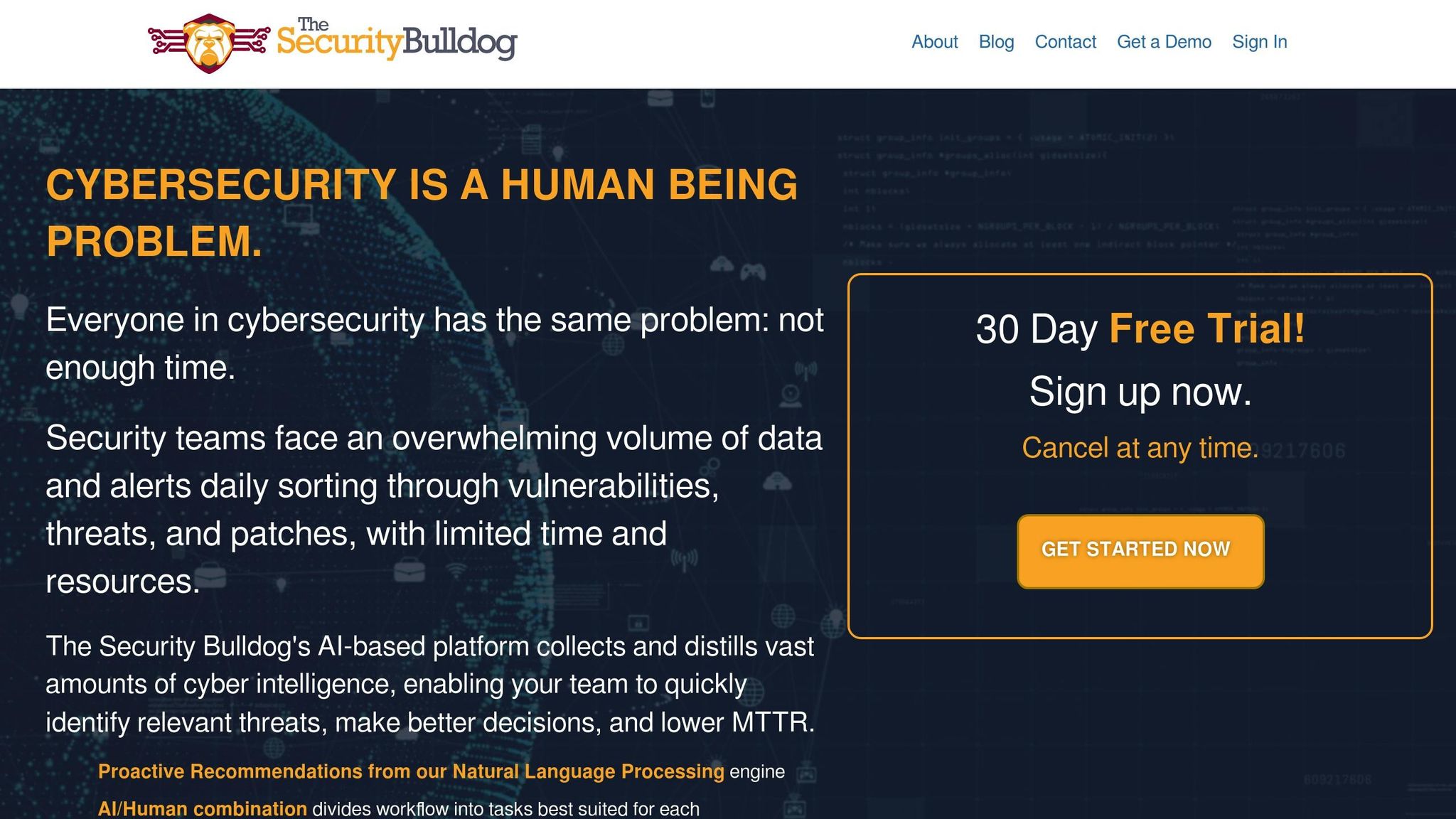
The Security Bulldog exemplifies how NLP transforms cybersecurity operations. Its NLP engine processes millions of documents daily, pulling data from a wide range of sources to identify actionable threat patterns. By doing so, it reduces manual research efforts by an impressive 80%, enabling faster threat identification and response.
Unlike basic keyword matching, The Security Bulldog’s NLP system understands context, connects information across multiple sources, and identifies patterns that signal emerging threats – even before they fully materialize. This proactive approach equips security teams to build defenses against potential attacks early on.
"Our proprietary natural language processing engine processes and presents the data they need in a human friendly way to reduce cognitive burden, improve decision making, and quicken remediation."
These examples highlight how NLP is reshaping cybersecurity, giving teams the tools they need to predict and counter threats more effectively.
sbb-itb-9b7603c
Benefits and Challenges of NLP in Deception Detection
Natural Language Processing (NLP) is changing the game in cybersecurity, especially when it comes to identifying deceptive threats. But while the technology offers some impressive advantages, it also comes with its fair share of hurdles. For organizations considering NLP, it’s important to weigh these benefits against the challenges to ensure successful implementation.
Benefits of NLP in Cyber Threat Detection
NLP offers a range of advantages, starting with its ability to handle massive amounts of data in real time. Every day, enterprise networks process millions of emails, documents, and communications. Manually analyzing this volume is impossible, but NLP systems can sift through it all instantly, flagging threats as they arise instead of after the damage is done.
Another major plus is the reduction in manual work. Automated NLP tools can cut down manual research time significantly, freeing up security analysts to focus on higher-level tasks rather than combing through endless streams of data. This efficiency boost leads to faster responses to threats and shorter remediation times.
Accuracy is another area where NLP shines. The technology can detect subtle linguistic cues – like typos, odd grammar, or unusual phrases – that often appear in phishing emails or other malicious communications. Unlike older rule-based systems, NLP models can adapt to new threats without constant manual updates, making them more flexible in handling evolving attack patterns.
NLP also has multilingual capabilities, which is a huge advantage in combating global cyber threats. It can analyze deceptive patterns across multiple languages at once, giving organizations broader protection against international attackers.
Finally, NLP systems can operate around the clock, providing 24/7 monitoring and instant alerts. This ensures that threats are flagged even during off-hours, giving organizations continuous protection.
Challenges and Limitations of NLP
Despite these benefits, NLP isn’t without its challenges. One major issue is the risk of adversarial attacks. Skilled attackers can manipulate NLP systems by using tactics like synonym substitution or subtle grammatical tweaks to evade detection while still delivering harmful content.
Data privacy and compliance concerns also come into play. NLP systems often require access to large volumes of communication data, which can raise red flags in industries with strict privacy regulations. Balancing effective threat detection with ethical data use can be a complex task.
Another challenge lies in the complexity of human language. Context, sarcasm, cultural nuances, and implied meanings can easily trip up even the most advanced NLP models. This can lead to false positives or, worse, missed threats – especially in attacks that rely on social engineering.
The costs of implementing and maintaining NLP systems can also be a barrier. Beyond the initial setup, these systems require ongoing training, updates, and skilled personnel to keep them running smoothly. For many organizations, this means a significant investment in both technology and expertise.
Lastly, the lack of transparency in many NLP models can be a problem. These "black box" systems often make decisions in ways that are difficult to understand, which can complicate incident response and make it harder to refine detection methods over time.
Comparison Table of Benefits vs. Challenges
| Benefits | Challenges |
|---|---|
| Real-time threat detection | Vulnerability to adversarial attacks |
| Significant reduction in manual workload | Data privacy and compliance issues |
| Enhanced accuracy in spotting subtle patterns | Difficulty handling language complexity and ambiguity |
| Multilingual threat analysis | High costs for implementation and upkeep |
| 24/7 automated monitoring | Limited transparency in AI decision-making |
The effectiveness of NLP ultimately depends on how well an organization can balance its advantages with these challenges. Success requires thoughtful implementation, regular maintenance, and seamless integration into existing security processes. For organizations willing to invest in addressing these obstacles, NLP can significantly enhance their ability to detect and respond to cyber threats.
Future Directions for NLP in Cybersecurity
Cybersecurity is advancing rapidly, and natural language processing (NLP) is playing a critical role in staying ahead of threats. With developments in predictive analytics and deeper integration with current security tools, the focus is shifting from reactive defense to proactive threat prevention. This marks a transformative step in how NLP is applied to cybersecurity.
Predictive Analytics and Pre-Emptive Threat Identification
One of the most exciting areas in NLP-driven cybersecurity is predictive analytics – using advanced models to spot and address potential threats before they can cause harm. Traditional security systems often react only after an attack begins, but modern NLP tools are changing the game. By analyzing patterns in cyber intelligence, these systems can offer proactive insights and recommendations.
For instance, NLP systems with self-learning capabilities can refine their threat detection models as they process new data. Imagine a scenario where the system identifies a surge in phishing-related terms across various sources. This could indicate an upcoming coordinated attack, allowing security teams to act before the attack unfolds. The real power of predictive analytics lies in its ability to process massive amounts of data in real time. By scanning diverse sources of information, these systems can uncover emerging threats and attack strategies early, giving organizations the chance to implement preventive measures.
Integration with Existing Cybersecurity Tools
Security teams often face the daunting task of managing overwhelming amounts of data and alerts. NLP platforms help tackle this issue by integrating seamlessly with existing security tools like SOAR (Security Orchestration, Automation, and Response) and SIEM (Security Information and Event Management) systems.
Take The Security Bulldog as an example. This platform connects directly with established cybersecurity tools and workflows, simplifying complex data streams into actionable insights within familiar environments. By doing so, it reduces the mental load on security teams and speeds up response times.
Easy setup and smooth onboarding are crucial for successful integration. Security teams can’t afford to waste time on complicated configurations that disrupt their workflows. Modern NLP solutions emphasize collaboration, enabling teams to share situational insights and receive proactive recommendations within their existing systems. This not only reduces the Mean Time to Response (MTTR) but also minimizes the need for manual threat analysis. These integrations pave the way for addressing future challenges in research and ethics.
Research and Ethical Considerations
As NLP continues to evolve, researchers are focusing on making systems more robust, transparent, and ethically sound. For example, new models are being designed to detect when they are being deliberately manipulated, while also offering clearer decision-making processes that analysts can understand and trust. This transparency is essential for resisting adversarial tactics.
Another growing area of focus is multilingual capability. Cyberattacks often span multiple languages, with attackers using linguistic diversity to evade detection. Future NLP systems will need to analyze deceptive patterns across dozens of languages simultaneously to address this global challenge effectively.
Data privacy remains a significant concern. NLP systems need access to large datasets to function, but organizations must balance this requirement with strict privacy regulations, especially in industries like healthcare and finance. Ethical data use is becoming a cornerstone of NLP research, ensuring that systems respect privacy while maintaining high levels of threat detection.
Additionally, NLP-powered chatbots and virtual assistants are emerging as valuable tools for automated incident response. These systems can provide around-the-clock support during security breaches, guiding teams through protocols and speeding up recovery efforts.
The future of NLP in cybersecurity hinges on finding the right balance between technical innovation and ethical responsibility. By building systems that detect sophisticated threats, operate transparently, respect privacy, and withstand adversarial manipulation, organizations can strengthen their defenses in an increasingly complex cybersecurity landscape.
Conclusion: The Role of NLP in Cybersecurity
Key Takeaways
Natural Language Processing (NLP) has reshaped the way organizations detect and respond to increasingly deceptive cyber threats. By handling massive volumes of threat intelligence, NLP enables security teams to work with greater speed and precision in identifying risks.
Unlike traditional rule-based systems, NLP excels at uncovering subtle language cues that often go unnoticed. It analyzes inconsistencies in communication, detects anomalies in sender behavior, and identifies manipulative patterns – even across multiple languages. This makes NLP a powerful tool against sophisticated social engineering and multilingual attacks, which are becoming more frequent and complex.
Take The Security Bulldog as an example. This advanced NLP platform processes millions of documents daily, turning raw data into actionable insights. By cutting manual research time by 80%, it allows cybersecurity teams to make quicker, more informed decisions.
NLP doesn’t just identify current threats – it also predicts emerging tactics. With 24/7 automated systems, such as NLP-powered chatbots, incident response becomes more efficient. These platforms provide a robust defense against deceptive threats while integrating seamlessly with existing tools, helping to reduce Mean Time to Response (MTTR). This highlights the growing and lasting influence of NLP on cybersecurity.
Final Thoughts
NLP is transforming threat detection and response in today’s cybersecurity landscape. Research and real-world applications show that NLP has become a cornerstone of modern cybersecurity strategies. Organizations that delay adopting NLP-driven solutions risk falling behind, especially when facing advanced phishing schemes and multilingual social engineering tactics.
For cybersecurity teams, the advantages of NLP are immediate and clear. Its ability to process vast amounts of data, detect nuanced language-based deceptions, and offer proactive threat insights makes it an essential tool in the fight against cybercrime.
Looking ahead, advancements in predictive analytics and deeper integrations with other tools promise even greater potential. As machine-to-machine communication evolves and adversaries refine their tactics, NLP systems will continue to adapt to these challenges.
When choosing an NLP solution, organizations should look for platforms with strong integration capabilities, robust multilingual support, and transparent decision-making processes. NLP is no longer a futuristic concept – it’s a proven method that enhances threat detection accuracy and speeds up response times, equipping organizations to handle an increasingly deceptive and complex threat environment.
FAQs
How does NLP enhance the detection of phishing and fraud compared to traditional cybersecurity methods?
Natural Language Processing (NLP) offers a powerful edge in cybersecurity by examining and understanding the language used in phishing and fraud schemes. Unlike older methods that lean on static rules or signature-based detection, NLP can pick up on subtle patterns, deceptive wording, and contextual hints that traditional systems often overlook.
For example, The Security Bulldog uses an advanced NLP engine to help cybersecurity teams break down complex threat data, spot suspicious communication patterns, and take action more efficiently. This approach not only speeds up threat detection but also cuts down on false positives, freeing up valuable time and resources for other critical tasks.
What challenges do organizations face when using NLP for cybersecurity, and how can they overcome them?
When implementing Natural Language Processing (NLP) in cybersecurity, organizations face several obstacles. These include managing massive amounts of unstructured data, ensuring precise threat detection, and seamlessly integrating NLP tools into their existing security frameworks. On top of that, the ever-evolving nature of cyber threats, often involving subtle and deceptive language patterns, adds another layer of difficulty.
To tackle these issues, businesses can turn to AI-driven platforms specifically built for cybersecurity. Platforms equipped with proprietary NLP engines can help sift through and analyze large datasets, uncover hidden patterns in malicious communications, and deliver actionable insights. Additionally, providing thorough training for security teams and consistently updating NLP models are key steps to improving detection accuracy and staying ahead of new and emerging threats.
How does NLP identify threats in multiple languages, and why is this critical for global cybersecurity?
Natural Language Processing (NLP) plays a critical role in analyzing and understanding text across multiple languages. This ability is particularly important in cybersecurity, as cybercriminals often exploit multilingual tactics to bypass detection, especially when targeting international organizations operating in diverse regions.
By handling multilingual data, NLP empowers security teams to identify suspicious patterns, phishing schemes, and harmful communications in any language. This approach strengthens defenses against global cyber threats, ensuring quicker and more precise threat identification and response.